 English
  Русский
  中文
中文  Español
  Deutsch
  Français
  Português
  Italiano
  日本語
日本語  한국어
한국어  Türkçe
  Polski
  Nederlands
  العربية
  हिन्दी
  Bahasa Indonesia
  Tiếng Việt
 What a network switch is
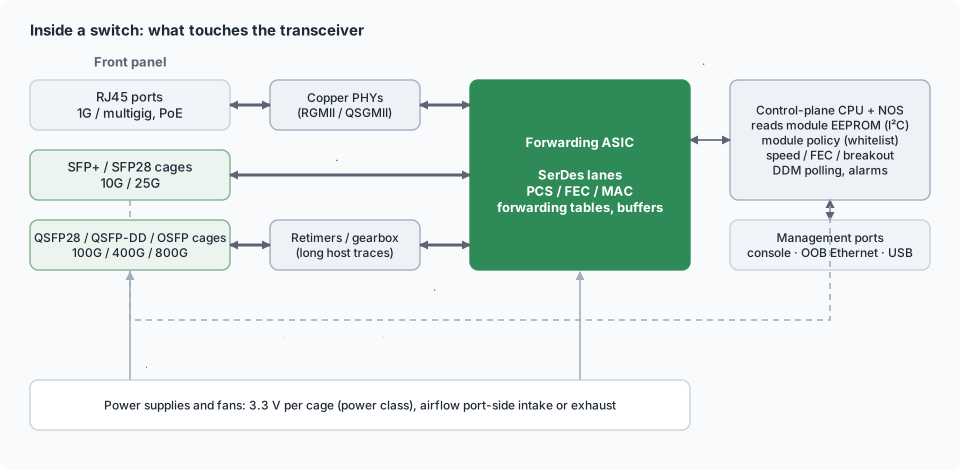
A network switch is a box of ports and a forwarding engine: frames arrive on one port and leave on the port where the destination lives. Behind that one sentence sit several layers that decide whether an optical module works — the silicon that drives the port, the cage that holds the module, the software that reads its memory and decides to trust it, the role the switch plays in the network and the management plane that reports what happened. This section walks through all of them from the transceiver's point of view; this page is the map.
What a switch does
| Function | Layer | What it means | Where to read more |
|---|---|---|---|
| Forwarding by MAC address | 2 | learns which MAC is behind which port, floods unknowns, isolates VLANs | Forwarding basics |
| Routing | 3 | most enterprise and all data-centre switches also route between subnets (ECMP, BGP/OSPF) | Forwarding basics |
| Link aggregation, redundancy | 2/3 | LAG/LACP, MLAG, spanning tree, stacking | Stacking & MLAG |
| Physical termination | 1 | cages, SerDes, PHYs — the part that touches the module | Inside a switch, Port types & cages |
| Management | — | CLI/API, SNMP, telemetry, syslog; reading transceiver EEPROMs and DDM | Management & monitoring |
Anatomy in one table
| Part | Job | Matters for optics because |
|---|---|---|
| Forwarding ASIC | switches/routes at line rate | its SerDes set the lane rates a port can run |
| Front-panel cages (RJ45, SFP, QSFP…) | hold modules and cables | family and generation decide what fits and how fast |
| PHYs, retimers, gearboxes | adapt ASIC lanes to ports | add speed/FEC limits; LPO needs direct ASIC attachment |
| Control-plane CPU + NOS | configures everything, reads modules over I²C | applies the vendor's module policy |
| Power supplies and fans | feed ASIC and up to 1 kW of optics; move air | cage power budget, airflow direction, module temperature |
| Management ports (console, OOB Ethernet, USB) | access when the network is down | where you see show interfaces transceiver |
Details: Inside a switch; the classes of boxes that package these parts: Switch classes & form factors.
Where switches sit
| Position | Typical ports | Optics |
|---|---|---|
| Access / leaf | 24–48 copper or SFP28 downlinks, 2–8 uplinks | DAC in rack, SR/LR uplinks |
| Distribution / aggregation / spine | all-fibre 25G–400G | SR4/DR4/FR4/LR4 |
| Core / super-spine / border | 100G–800G, long-reach | LR4, ER4, ZR/ZR+, CWDM/DWDM |
| Management (OOB) | 1G copper/SFP | LX to the OOB core |
Roles, topologies and how to count optics from a design: Switch roles & topologies.
Switches and transceivers
- The cage decides what fits mechanically and which lane rates are possible (Port types & cages).
- On insertion the NOS reads the module's EEPROM over the two-wire bus: identity, compliance codes, power class (Host initialization).
- It validates the module against its policy — from "anything that parses" to strict OEM whitelists (How each NOS validates a module).
- It configures the port — speed, FEC, auto-negotiation, breakout — from the module's declared capabilities and the operator's commands (Port configuration recipes).
- It polls DDM and raises alarms; the management plane exports them (Management & monitoring).
CodingBox reads and codes the very memory a switch inspects in step 2, so that a module presents the identity the switch expects in step 3 (Vendor lock & coding).
The other end: network cards
The server side plays the same game with a driver instead of a NOS and PCIe instead of a fabric ASIC — NICs with optical ports. The electrical interface between MAC, PHY and cage on both sides (SGMII, SFI, CAUI-4, 400GAUI-8) is in Media-independent interfaces.
Further reading
- Switch classes & form factors — fixed, modular/chassis, stackable, industrial, white-box; redundancy, airflow direction and why it matters for optics.
- Inside a switch — ASIC and SerDes generations, port groups and speed constraints, PHYs and retimers, control plane and the two-wire bus, power and cooling.
- Ports and uplinks — port roles, access vs trunk vs uplink, oversubscription, uplink modules, LAG on uplinks, choosing uplink optics.
- Port types & cages — the fit-and-function matrix from SFP to OSFP-XD, combo ports, QSA adapters, breakout and speed-group rules.
- Port naming & LEDs — interface names per NOS, breakout child notation, slot/port semantics, what the LEDs mean.
- Stacking, virtual chassis & MLAG — StackWise, VSF/VSX, Virtual Chassis, IRF, iStack, VLT, vPC/MLAG and their optics.
- Forwarding basics — VLANs, trunks, spanning tree, LAG, routing and ECMP, and how physical-layer faults surface there.
- Switch roles & topologies — campus tiers and leaf–spine mapped to optics, distances and counts.
- Management & monitoring — console, OOB, CLI/API, SNMP MIBs and telemetry paths for transceiver data, syslog, upgrades.
- Selecting & commissioning a switch — selection criteria with optics in mind and a commissioning checklist through to the DDM baseline.
In CodingBox
Every step where the switch touches the module — identity read, validation, speed and power negotiation, DDM — is a read or write of bytes that CodingBox shows on the bench, so the switch-side outcome can be predicted before the module is racked (Check transceiver).