 English
  简体中文
简体中文  繁體中文
繁體中文  Русский
  Español
  Deutsch
  Français
  Português
  Italiano
  Türkçe
  Polski
  Nederlands
  日本語
日本語  한국어
한국어  Bahasa Indonesia
  Bahasa Melayu
  العربية
  हिन्दी
  Tiếng Việt
  ภาษาไทย
  বাংলা
বাংলা  اردو
اردو  Kiswahili
  Oʻzbekcha
  አማርኛ
አማርኛ  فارسی
فارسی Was ein Netzwerk-Switch ist
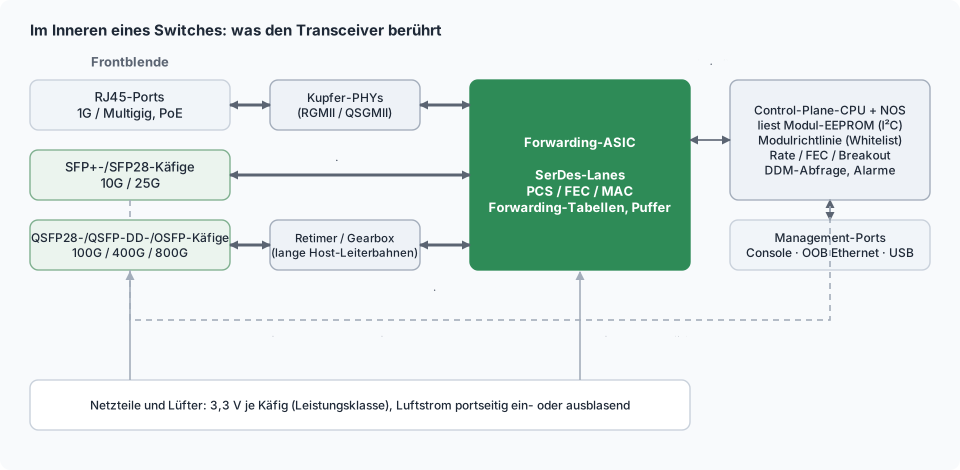
Ein Netzwerk-Switch ist eine Kiste aus Ports und einer Forwarding-Engine: Frames kommen an einem Port an und verlassen den Switch am Port, hinter dem das Ziel liegt. Hinter diesem einen Satz stecken mehrere Schichten, die darüber entscheiden, ob ein optisches Modul funktioniert — das Silizium, das den Port ansteuert, der Käfig, der das Modul aufnimmt, die Software, die dessen Speicher liest und entscheidet, ob sie ihm vertraut, die Rolle, die der Switch im Netzwerk spielt, und die Management-Ebene, die meldet, was passiert ist. Dieser Abschnitt geht all das aus Sicht des Transceivers durch; diese Seite ist die Karte dazu.
Was ein Switch tut
| Funktion | Schicht | Was es bedeutet | Wo mehr dazu steht |
|---|---|---|---|
| Forwarding nach MAC-Adresse | 2 | lernt, welche MAC hinter welchem Port liegt, flutet Unbekanntes, isoliert VLANs | Forwarding-Grundlagen |
| Routing | 3 | die meisten Enterprise- und alle Rechenzentrums-Switches routen auch zwischen Subnetzen (ECMP, BGP/OSPF) | Forwarding-Grundlagen |
| Link Aggregation, Redundanz | 2/3 | LAG/LACP, MLAG, Spanning Tree, Stacking | Stacking & MLAG |
| Physische Terminierung | 1 | Käfige, SerDes, PHYs — der Teil, der das Modul berührt | Innenleben eines Switches, Port-Typen & Käfige |
| Management | — | CLI/API, SNMP, Telemetrie, Syslog; Lesen von Transceiver-EEPROMs und DDM | Management & Monitoring |
Anatomie in einer Tabelle
| Teil | Aufgabe | Warum das für Optik zählt |
|---|---|---|
| Forwarding-ASIC | switcht/routet mit Leitungsgeschwindigkeit | seine SerDes legen fest, welche Lane-Raten ein Port fahren kann |
| Front-Panel-Käfige (RJ45, SFP, QSFP…) | nehmen Module und Kabel auf | Familie und Generation entscheiden, was passt und wie schnell |
| PHYs, Retimer, Gearboxes | passen ASIC-Lanes an Ports an | fügen Geschwindigkeits-/FEC-Grenzen hinzu; LPO braucht direkten ASIC-Anschluss |
| Control-Plane-CPU + NOS | konfiguriert alles, liest Module über I²C aus | wendet die Modul-Policy des Herstellers an |
| Netzteile und Lüfter | versorgen ASIC und bis zu 1 kW Optik; bewegen Luft | Käfig-Leistungsbudget, Luftstromrichtung, Modultemperatur |
| Management-Ports (Konsole, OOB-Ethernet, USB) | Zugriff, wenn das Netzwerk down ist | wo Sie show interfaces transceiver sehen |
Details: Innenleben eines Switches; die Geräteklassen, die diese Teile verpacken: Switch-Klassen & Formfaktoren.
Wo Switches stehen
| Position | Typische Ports | Optik |
|---|---|---|
| Access / Leaf | 24–48 Kupfer- oder SFP28-Downlinks, 2–8 Uplinks | DAC im Rack, SR/LR-Uplinks |
| Distribution / Aggregation / Spine | reine Faser, 25G–400G | SR4/DR4/FR4/LR4 |
| Core / Super-Spine / Border | 100G–800G, Weitreichend | LR4, ER4, ZR/ZR+, CWDM/DWDM |
| Management (OOB) | 1G Kupfer/SFP | LX zum OOB-Core |
Rollen, Topologien und wie sich Optik aus einem Design abzählen lässt: Switch-Rollen & Topologien.
Switches und Transceiver
- Der Käfig entscheidet, was mechanisch passt und welche Lane-Raten möglich sind (Port-Typen & Käfige).
- Beim Einsetzen liest das NOS das EEPROM des Moduls über den Zweidraht-Bus: Identität, Compliance-Codes, Leistungsklasse (Host-Initialisierung).
- Es validiert das Modul gegen seine Policy — von „alles, was sich parsen lässt“ bis zu strikten OEM-Whitelists (Wie jedes NOS ein Modul prüft).
- Es konfiguriert den Port — Geschwindigkeit, FEC, Autonegotiation, Breakout — anhand der vom Modul gemeldeten Fähigkeiten und der Befehle des Betreibers (Port-Konfigurationsrezepte).
- Es fragt DDM ab und löst Alarme aus; die Management-Ebene exportiert sie (Management & Monitoring).
CodingBox liest und codiert genau den Speicher, den ein Switch in Schritt 2 prüft, damit ein Modul in Schritt 3 die vom Switch erwartete Identität präsentiert (Herstellersperre & Codierung).
Das andere Ende: Netzwerkkarten
Die Serverseite spielt dasselbe Spiel, nur mit einem Treiber statt einem NOS und PCIe statt einem Fabric-ASIC — NICs mit optischen Ports. Die elektrische Schnittstelle zwischen MAC, PHY und Käfig auf beiden Seiten (SGMII, SFI, CAUI-4, 400GAUI-8) steht in Medienunabhängige Schnittstellen.
Weiterführend
- Switch-Klassen & Formfaktoren — fest, modular/Chassis, stapelbar, industriell, White-Box; Redundanz, Luftstromrichtung und warum das für Optik zählt.
- Innenleben eines Switches — ASIC- und SerDes-Generationen, Port-Gruppen und Geschwindigkeitsgrenzen, PHYs und Retimer, Control-Plane und der Zweidraht-Bus, Strom und Kühlung.
- Ports und Uplinks — Port-Rollen, Access vs. Trunk vs. Uplink, Überbuchung, Uplink-Module, LAG auf Uplinks, Wahl der Uplink-Optik.
- Port-Typen & Käfige — die Fit-and-Function-Matrix von SFP bis OSFP-XD, Combo-Ports, QSA-Adapter, Breakout- und Speed-Group-Regeln.
- Port-Benennung & LEDs — Interface-Namen je NOS, Breakout-Child-Notation, Slot-/Port-Semantik, Bedeutung der LEDs.
- Stacking, Virtual Chassis & MLAG — StackWise, VSF/VSX, Virtual Chassis, IRF, iStack, VLT, vPC/MLAG und deren Optik.
- Forwarding-Grundlagen — VLANs, Trunks, Spanning Tree, LAG, Routing und ECMP, und wie physische Fehler sich dort zeigen.
- Switch-Rollen & Topologien — Campus-Ebenen und Leaf-Spine auf Optik, Distanzen und Stückzahlen abgebildet.
- Management & Monitoring — Konsole, OOB, CLI/API, SNMP-MIBs und Telemetrie-Pfade für Transceiver-Daten, Syslog, Upgrades.
- Switch auswählen & in Betrieb nehmen — Auswahlkriterien mit Blick auf Optik und eine Inbetriebnahme-Checkliste bis zur DDM-Baseline.
In CodingBox
Jeder Schritt, in dem der Switch das Modul berührt — Identitäts-Read, Validierung, Geschwindigkeits- und Leistungsaushandlung, DDM — ist ein Lesen oder Schreiben von Bytes, die CodingBox auf der Werkbank anzeigt, sodass sich das Ergebnis auf der Switch-Seite vorhersagen lässt, bevor das Modul ins Rack kommt (Check transceiver).