 English
  简体中文
简体中文  繁體中文
繁體中文  Русский
  Español
  Deutsch
  Français
  Português
  Italiano
  Türkçe
  Polski
  Nederlands
  日本語
日本語  한국어
한국어  Bahasa Indonesia
  Bahasa Melayu
  العربية
  हिन्दी
  Tiếng Việt
  ภาษาไทย
  বাংলা
বাংলা  اردو
اردو  Kiswahili
  Oʻzbekcha
  አማርኛ
አማርኛ  فارسی
فارسی Qu’est-ce qu’un commutateur réseau
Un commutateur réseau est un boîtier de ports et un moteur d’acheminement : les trames arrivent sur un port et repartent par le port où se trouve la destination. Derrière cette phrase se cachent plusieurs couches qui décident si un module optique fonctionne : le silicium qui pilote le port, la cage qui reçoit le module, le logiciel qui lit sa mémoire et décide de lui faire confiance, le rôle que joue le commutateur dans le réseau, et le plan de gestion qui rapporte ce qui s’est passé. Cette section parcourt chacune de ces couches du point de vue du transceiver ; cette page en est la carte.
Ce que fait un commutateur
| Fonction | Couche | Ce que cela signifie | Pour en savoir plus |
|---|---|---|---|
| Acheminement par adresse MAC | 2 | apprend quelle MAC se trouve derrière quel port, inonde les destinations inconnues, isole les VLAN | Notions d’acheminement |
| Routage | 3 | la plupart des commutateurs d’entreprise et tous ceux de centre de données routent aussi entre les sous-réseaux (ECMP, BGP/OSPF) | Notions d’acheminement |
| Agrégation de liens, redondance | 2/3 | LAG/LACP, MLAG, spanning tree, stacking | Stacking et MLAG |
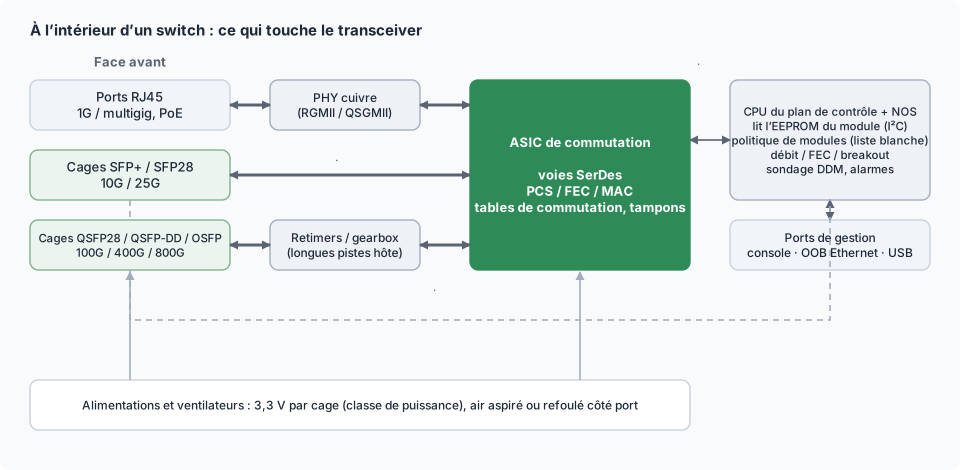
| Terminaison physique | 1 | cages, SerDes, PHY : la partie qui touche le module | À l’intérieur d’un commutateur, Types de ports et cages |
| Gestion | — | CLI/API, SNMP, télémétrie, syslog ; lecture des EEPROM et du DDM des transceivers | Gestion et surveillance |
Anatomie en un tableau
| Élément | Rôle | Pourquoi c’est important pour l’optique |
|---|---|---|
| ASIC d’acheminement | commute/route au débit ligne | ses SerDes déterminent les débits de voie qu’un port peut atteindre |
| Cages en face avant (RJ45, SFP, QSFP…) | reçoivent modules et câbles | la famille et la génération déterminent ce qui rentre et à quelle vitesse |
| PHY, retimers, gearboxes | adaptent les voies de l’ASIC aux ports | ajoutent des limites de vitesse/FEC ; le LPO nécessite un raccordement direct à l’ASIC |
| CPU du plan de contrôle + NOS | configure tout, lit les modules via I²C | applique la politique du constructeur pour les modules |
| Alimentations et ventilateurs | alimentent l’ASIC et jusqu’à 1 kW d’optiques ; déplacent l’air | budget de puissance par cage, sens du flux d’air, température du module |
| Ports de gestion (console, Ethernet OOB, USB) | accès quand le réseau est en panne | là où s’affiche show interfaces transceiver |
Détails : À l’intérieur d’un commutateur ; les classes de boîtiers qui rassemblent ces éléments : Classes de commutateurs et facteurs de forme.
Où se situent les commutateurs
| Position | Ports typiques | Optiques |
|---|---|---|
| Accès / leaf | 24–48 downlinks cuivre ou SFP28, 2–8 uplinks | DAC en rack, uplinks SR/LR |
| Distribution / agrégation / spine | tout en fibre 25G–400G | SR4/DR4/FR4/LR4 |
| Cœur / super-spine / bordure | 100G–800G, longue portée | LR4, ER4, ZR/ZR+, CWDM/DWDM |
| Gestion (OOB) | cuivre/SFP 1G | LX vers le cœur OOB |
Rôles, topologies et comment compter les optiques à partir d’une conception : Rôles et topologies des commutateurs.
Commutateurs et transceivers
- La cage décide ce qui rentre mécaniquement et quels débits de voie sont possibles (Types de ports et cages).
- À l’insertion, le NOS lit l’EEPROM du module via le bus deux fils : identité, codes de conformité, classe de puissance (Initialisation côté hôte).
- Il valide le module selon sa politique : de « tout ce qui s’analyse correctement » aux listes blanches OEM strictes (Comment chaque NOS valide un module).
- Il configure le port — vitesse, FEC, autonégociation, éclatement (breakout) — à partir des capacités déclarées du module et des commandes de l’opérateur (Recettes de configuration des ports).
- Il interroge le DDM et déclenche des alarmes ; le plan de gestion les exporte (Gestion et surveillance).
CodingBox lit et code cette même mémoire que le commutateur inspecte à l’étape 2, afin qu’un module présente l’identité attendue par le commutateur à l’étape 3 (Verrouillage constructeur et codage).
L’autre extrémité : les cartes réseau
Côté serveur, c’est le même jeu, mais avec un pilote à la place d’un NOS et du PCIe à la place d’un ASIC de fabrique : Cartes réseau à ports optiques. L’interface électrique entre MAC, PHY et cage des deux côtés (SGMII, SFI, CAUI-4, 400GAUI-8) est traitée dans Interfaces indépendantes du média.
Pour aller plus loin
- Classes de commutateurs et facteurs de forme : fixe, modulaire/châssis, empilable, industriel, white-box ; redondance, sens du flux d’air et pourquoi cela compte pour l’optique.
- À l’intérieur d’un commutateur : générations d’ASIC et de SerDes, groupes de ports et contraintes de vitesse, PHY et retimers, plan de contrôle et bus deux fils, alimentation et refroidissement.
- Ports et uplinks : rôles des ports, accès vs trunk vs uplink, sursouscription, modules d’uplink, LAG sur les uplinks, choix des optiques d’uplink.
- Types de ports et cages : la matrice forme-et-fonction du SFP à l’OSFP-XD, ports combo, adaptateurs QSA, règles d’éclatement (breakout) et de groupe de vitesse.
- Nommage des ports et LED : noms d’interface selon le NOS, notation des enfants d’éclatement (breakout), sémantique slot/port, signification des LED.
- Stacking, châssis virtuel et MLAG : StackWise, VSF/VSX, Virtual Chassis, IRF, iStack, VLT, vPC/MLAG et leurs optiques.
- Notions d’acheminement : VLAN, trunks, spanning tree, LAG, routage et ECMP, et comment les défauts de couche physique s’y manifestent.
- Rôles et topologies des commutateurs : niveaux de campus et leaf-spine mis en correspondance avec les optiques, distances et quantités.
- Gestion et surveillance : console, OOB, CLI/API, MIB SNMP et chemins de télémétrie pour les données de transceiver, syslog, mises à niveau.
- Sélectionner et mettre en service un commutateur : critères de sélection en gardant l’optique à l’esprit, et une check-list de mise en service jusqu’à la référence DDM.
Dans CodingBox
Chaque étape où le commutateur touche au module — lecture d’identité, validation, négociation de vitesse et de puissance, DDM — est une lecture ou une écriture d’octets que CodingBox affiche au banc, ce qui permet de prédire le comportement du commutateur avant que le module soit monté en baie (Check transceiver).